The Hidden Dangers of DIY Pest Control: Why Professional Help Matters
DIY Pest Control: Why Professional Help Matters
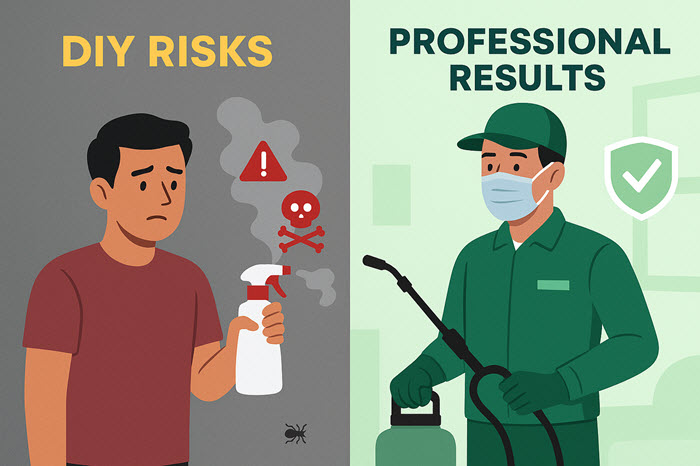
DIY pest control can seem like a convenient and affordable way to deal with ants, cockroaches, termites, rodents, and other household pests. You can buy products from stores, follow the instructions, and attempt to solve the problem yourself. However, while DIY pest control may help with minor pest activity, it can also create safety, effectiveness, and long-term prevention challenges when an infestation is more serious.
In many cases, the visible pests are only part of the problem. For example, seeing several cockroaches in your kitchen may indicate that more are hiding behind appliances, inside cabinets, or near plumbing areas. Similarly, termites may cause damage inside wood or other structural areas before their presence becomes obvious.
Therefore, understanding the limitations of DIY pest control can help homeowners and business owners decide when professional pest management is the safer and more practical option.
What Is DIY Pest Control?
DIY pest control refers to pest treatment performed by property owners or occupants rather than by a professional pest management provider. Common DIY approaches include traps, baits, sprays, insecticides, gels, repellents, and other commercially available products.
For a minor and clearly identified pest problem, some DIY methods may provide temporary control. However, the effectiveness of a treatment depends on the pest species, infestation level, location, environmental conditions, and correct application.
Moreover, using a product simply because it is advertised for a particular pest does not guarantee that it will solve the underlying infestation.
Why DIY Pest Control Does Not Always Solve the Problem
One of the biggest limitations of DIY pest control is that it often focuses on the pests that can be seen rather than the source of the infestation.
Pests may hide in wall voids, ceilings, drains, cabinets, storage areas, cracks, landscaping, and other locations that are difficult for homeowners to inspect. Consequently, killing visible insects may provide only temporary relief.
For example, spraying a cockroach that appears in the kitchen may eliminate that individual insect, but it does not necessarily address the food, moisture, shelter, or entry points attracting other cockroaches.
Likewise, placing a few traps may catch some rodents without identifying how they entered the building.
Professional pest management takes a broader approach by considering where pests are coming from, where they are hiding, and what conditions are allowing them to survive.
1. Incorrect Pest Identification Can Lead to the Wrong Treatment
Different pests require different management strategies.
Ants, cockroaches, termites, rodents, mosquitoes, and other pests have different behaviors, nesting habits, food sources, and hiding places. Therefore, correctly identifying the pest is an important first step.
If you mistake one pest for another, you may purchase and apply a treatment that is ineffective for the actual infestation.
A professional technician can inspect the property, identify signs of pest activity, and recommend an appropriate treatment strategy based on the conditions found.
2. DIY Pest Control Can Miss Hidden Infestations
Many pest infestations are larger than they initially appear.
Cockroaches, for instance, can hide in dark and protected areas during the day. Rodents can remain inside ceilings, walls, cabinets, or storage spaces. Termites can also remain concealed while causing damage over time.
As a result, treating only the areas where pests are visible may not eliminate the source.
Professional inspections can help identify potential hiding areas, entry points, food sources, moisture problems, and other conditions that contribute to pest activity.
3. Using Too Much Product Does Not Mean Better Results
Another common misconception about DIY pest control is that applying more product will produce better results.
In reality, pest control products should be used only according to their label directions and intended application. Increasing the amount or frequency without proper guidance can create unnecessary exposure and may not improve pest control.
Furthermore, products should be stored and handled carefully.
The Philippine Fertilizer and Pesticide Authority provides a registered products database that allows users to check registered agricultural pesticide products. (Fertilizer and Pesticide Authority)
The FPA has also issued advisories warning the public about fake, unregistered, mislabeled, or expired pesticide products. (Fertilizer and Pesticide Authority)
However, it is important to understand the regulatory distinction between agricultural pesticides and products intended for urban or household use. The FPA states that pesticides intended for urban and household use are outside its jurisdiction and that regulation was transferred to the Food and Drug Administration (FDA). (Fertilizer and Pesticide Authority)
Therefore, consumers should not assume that an agricultural registration automatically applies to every household pest-control product.
4. DIY Pest Control May Provide Only Temporary Relief
If an infestation keeps returning, the treatment may be addressing the symptoms rather than the cause.
For instance, recurring cockroach activity can be associated with accessible food, water, moisture, sanitation issues, cracks, or other hiding and entry points. Similarly, recurring ant activity may indicate an accessible food source or an established colony nearby.
Consequently, long-term pest management requires more than eliminating the insects you can see.
A professional approach combines treatment with inspection, prevention, monitoring, and recommendations for correcting conditions that encourage pest activity.
5. Some Pest Problems Require Professional Inspection
Certain infestations should not be approached as simple DIY projects.
Termites are a good example. Because termite activity can occur in concealed areas, homeowners may not recognize the extent of a problem simply by looking at visible damage.
Rodent infestations can also require more than traps. If rodents continue entering through gaps, openings, roofs, drains, or other access points, the infestation may continue even after several animals are caught.
In these situations, professional inspection can help determine the scope of the problem and identify potential entry points.
6. Professional Pest Control Uses a More Comprehensive Approach
Professional pest management is not simply about spraying a chemical.
A comprehensive service may include inspection, pest identification, targeted treatment, sanitation recommendations, exclusion recommendations, monitoring, and follow-up.
Instead of treating every part of a property unnecessarily, technicians can focus on areas where pest activity has been identified or where conditions make infestation more likely.
This targeted approach can help make pest treatment more systematic and practical.
7. Safety Should Be a Major Consideration
Safety is another important reason to think carefully before attempting DIY pest control.
Pest control products can require specific precautions involving application, storage, ventilation, food, occupants, pets, and treated areas. Therefore, users should always read and follow the product label and any applicable instructions.
If you are uncertain about a product or treatment method, it is better to seek professional advice rather than experiment with different products.
The FPA maintains information about licensed pesticide handlers and other regulated agricultural pesticide activities. Its current database includes licensed pesticide handlers and their license information. (Fertilizer and Pesticide Authority)
For businesses, additional considerations may apply because treatment can affect employees, customers, food preparation areas, inventory, and normal operations.
8. Professional Pest Control Can Help Businesses Protect Their Operations
Commercial properties often face more complicated pest management requirements than individual homes.
Restaurants, offices, warehouses, retail stores, and industrial facilities may need regular inspections and preventive pest management because pest activity can affect sanitation, property conditions, employees, customers, and business reputation.
Dash5 Pest Control provides commercial pest management programs for offices, warehouses, restaurants, retail stores, and industrial facilities. Its approach includes inspections, prevention, monitoring, and maintenance designed around individual business requirements. (Dash 5 Pest Control)
If you operate a business, learn more about Dash5 Commercial Pest Control to see how a professional pest management program can be structured for a commercial property.
9. DIY Pest Control Can Become More Expensive Over Time
DIY treatment may appear cheaper because you only pay for the products you purchase.
However, repeated unsuccessful treatments can add up.
You may purchase different sprays, traps, baits, repellents, or other products while the underlying infestation continues. Eventually, you may spend more than you would have spent on a professional inspection and treatment plan.
Therefore, the better question is not simply, “How much does this product cost?”
Instead, consider the total cost of repeated treatments, property damage, lost time, business disruption, and continued pest activity.
10. Professional Help Can Address the Source of the Infestation
One of the biggest advantages of professional pest management is the focus on identifying why pests are present.
A technician may look for:
- Food sources
- Water and moisture
- Cracks and openings
- Plumbing penetrations
- Structural gaps
- Nesting or harborage areas
- Improper waste storage
- Clutter and inaccessible areas
- Landscaping conditions
- Other potential pest entry points
Once these conditions are identified, the property owner can take corrective steps in addition to the treatment itself.
As a result, professional pest management can focus not only on eliminating existing pests but also on reducing the conditions that allow them to return.
When Should You Stop DIY Pest Control and Call a Professional?
DIY pest control may be reasonable for a small and clearly identified pest problem. However, professional help should be considered when:
- The infestation keeps returning.
- You cannot identify the pest.
- You see pests in multiple areas.
- You find signs of termites or structural damage.
- Rodents continue appearing after traps are used.
- Cockroaches remain active after repeated treatments.
- The infestation is spreading.
- You are concerned about product safety.
- You manage a restaurant, office, warehouse, or other commercial property.
- You need a preventive pest management program.
In particular, recurring infestations are a strong indication that the underlying cause may not have been addressed.
DIY Pest Control vs. Professional Pest Control
The main difference is the overall approach.
DIY pest control generally involves purchasing and applying products yourself. It can be useful for certain minor problems, but results depend heavily on correct pest identification, product selection, application, and follow-through.
Professional pest control typically involves inspection, identification, targeted treatment, prevention recommendations, monitoring, and follow-up when required.
Neither approach should be viewed as appropriate for every situation. Instead, the right choice depends on the pest, severity of the infestation, property type, safety considerations, and desired long-term outcome.
How to Choose a Professional Pest Control Company
If DIY pest control is no longer producing satisfactory results, take time to evaluate the company you plan to hire.
Look for a provider that:
- Explains the problem clearly.
- Conducts an appropriate inspection.
- Identifies the pest before recommending treatment.
- Explains the treatment process.
- Provides preparation and safety instructions.
- Offers preventive recommendations.
- Communicates clearly about follow-up service.
- Has experience with residential or commercial properties.
- Provides clear contact and service information.
Furthermore, do not choose a company based solely on the lowest price. Compare the complete service, treatment approach, communication, and long-term value.
You can also read our guide on how to choose the right pest control company for your home or business for additional questions to ask before hiring a provider.
Why Choose Dash5 Pest Control?
If repeated DIY pest control treatments have not solved your pest problem, professional assistance may be the next practical step.
Dash5 Pest Control provides pest management solutions designed for residential and commercial properties. Professional service can help identify pest activity, determine possible causes, and develop a treatment approach based on the property’s specific conditions.
For businesses, Dash5 offers commercial pest control programs designed for different environments, including offices, warehouses, restaurants, retail stores, and industrial facilities.
You can also visit the Dash5 Pest Control homepage to learn more about available pest management services.
Frequently Asked Questions About DIY Pest Control
Is DIY pest control effective?
DIY pest control can be effective for some minor and clearly identified pest problems. However, recurring, widespread, or hidden infestations may require professional inspection and treatment.
Is DIY pest control cheaper than professional pest control?
The initial cost may be lower because you purchase the products yourself. However, repeated unsuccessful treatments can increase the total cost. Professional service may provide better value when an infestation is persistent or difficult to identify.
Can I use multiple pest control products together?
Do not combine or mix pest control products unless the product label specifically permits it. Using products incorrectly can create unnecessary safety risks and may not improve effectiveness.
When should I call a professional pest control company?
Consider professional help when the infestation continues after DIY treatment, the pest cannot be identified, the problem is widespread, structural damage is suspected, or you are concerned about applying pest control products safely.
Can professional pest control prevent pests from coming back?
Professional pest management can help reduce the likelihood of recurring infestations by combining treatment with inspection, monitoring, and recommendations for addressing food, water, shelter, and entry points.
Final Thoughts
DIY pest control can be useful in some situations, but it is not always the best solution for persistent, widespread, or difficult-to-identify infestations.
More importantly, repeatedly treating visible pests without addressing the underlying conditions can allow an infestation to continue.
Professional pest management provides a more comprehensive approach by combining inspection, pest identification, targeted treatment, prevention, and monitoring. Therefore, when DIY methods are no longer producing results, professional help can save time, reduce repeated treatment attempts, and provide a more systematic path toward long-term pest control.
If you are dealing with recurring pests at home or at your business, consider having the property professionally assessed rather than continuing to experiment with different DIY treatments.